

Generational Arbitrage
Your most experienced people don't know how to use the tools. Your AI natives don't know what to build. That gap is costing you more than you think.

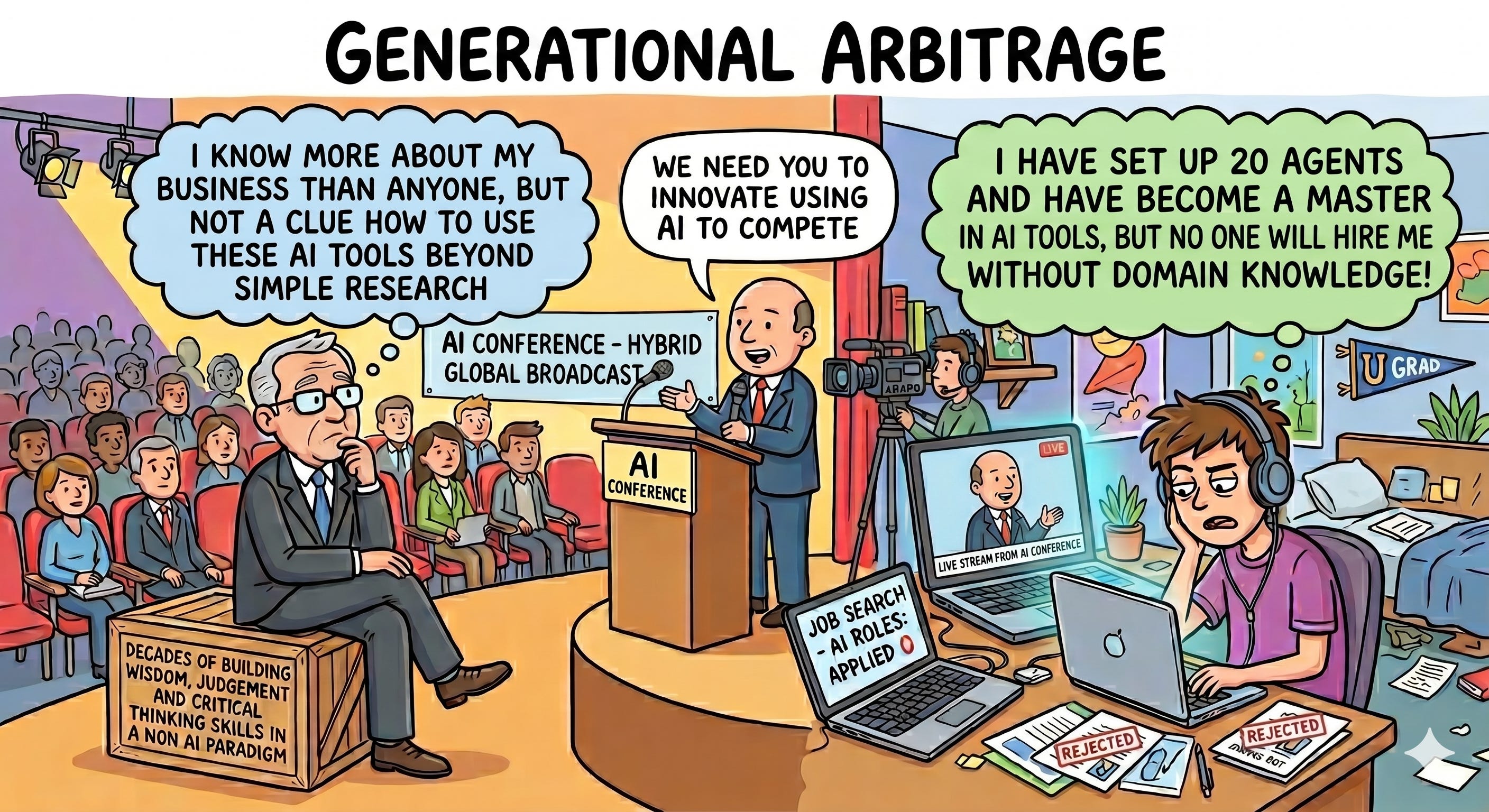
Generational gaps are one of the great running jokes of human civilization, and they have always followed roughly the same script. The older generation watches the younger generation embrace something incomprehensible, declares with absolute certainty that this new thing will be the ruin of society, and then gradually makes peace with it just in time to be horrified by whatever comes next. Elvis Presley’s hips were, at one point, considered a legitimate threat to American moral fabric, and the cameras at the Ed Sullivan Show were instructed to film him only from the waist up. Rock and roll was satanic, then disco was the death of music, then hip hop was the death of music, and then Spotify playlists became the death of music. There was a stretch of years in the 1980s when serious adults genuinely believed that Dungeons and Dragons was a recruitment pipeline for the occult, which is a sentence I cannot type without a small smile, having spent my own formative years rolling polyhedral dice at the kitchen table. Video games were going to produce a generation of unemployable zombies. Texting was going to destroy the English language. Avocado toast, somehow, was responsible for an entire generation’s inability to buy houses. The young have always been ruining things, and the old have always been there to point it out, and the historical record of these complaints turns out to be both consistent and consistently wrong.
The current generational gap, however, is not about taste, and that is the part that makes it different. Every previous version of this conflict was an argument about sensibility. The current gap is about something far more consequential, which is to say it is about value, in the literal economic sense, and the inability of two generations to bridge it is the single largest reason artificial intelligence is failing to deliver on its actual potential inside most organizations right now.
The structure of the disconnect is shrouded in the uncertainty that we are all trying to adapt to, with the art of what is objectively possible changing on almost a daily basis. The people who most deeply understand what critical business opportunities lie, the ones who have spent decades developing the strategic judgment to recognize a real opportunity from a fashionable one, are largely the people who do not know how to use the AI tools transformationally, outside of their “old model” indoctrinated thinking. And the people who know how to use the tools creatively, who can spin up something genuinely capable in an afternoon and who think in prompts and pipelines as a kind of native language, are largely the people who do not yet have the experience to know what to apply them to. Two populations, sitting in adjacent rooms, each holding precisely what the other lacks, and most organizations have not figured out how to bring them into the same conversation in a way that actually unlocks the spread between them.
I have come to call this gap Generational Arbitrage, and the more time I spend working with it directly, the more convinced I become that closing it is going to be the defining business challenge of the next 5 years.
The term comes from finance, where arbitrage describes the practice of capturing value from a difference between two markets where the same asset is priced or valued differently. The conditions are always the same regardless of the asset class, which is to say there has to be a real gap, the gap has to be temporary, and someone has to recognize it and act before everyone else does. What we have at this particular moment in professional life, across consulting and most knowledge-based industries, is exactly that kind of spread, and it is unusually wide. On one side of canyon you have seasoned masters with thirty years of accumulated wisdom, judgment, pattern recognition, and the ability to walk into a room and immediately diagnose what the actual problem is rather than the problem the client believes they have. They have, in other words, the part of the equation that no amount of compute can replicate, but they are reluctant operators of the new tools and many of them are quietly hoping the whole disruption will turn out to be less significant than it looks. On the other side you have a generation of young professionals who are actively growing up with these tools as instruments rather than novelties, who can build at a velocity that would have seemed absurd a few years ago, and who carry exactly none of the scar tissue that teaches a person why something that looks promising in the demo will fall apart the moment it meets a real client. Both sides are sitting on assets the other side cannot fully value, which is the textbook definition of arbitrage conditions, and the spread between what each holds and what neither can capture alone is enormous.
The reason most organizations are not capturing this value is structural rather than technical. Senior people sit in one set of meetings, the AI work happens somewhere else, usually staffed by junior practitioners or a specialized team that reports to a chief technology officer who does not sit at the table where the real strategic decisions are being made. The seasoned master receives the AI output as a finished thing, evaluates it through the lens of the old paradigm, and either rejects it outright or accepts a watered-down version of what it could have been. The young AI native produces capability without context, watches the output get diluted by people who never quite understood what they were looking at, and concludes that the company is not serious about transformation. Both perspectives are partially right and entirely stuck, which is what happens when an organization is sitting on top of a real arbitrage opportunity but has built its meeting structure to keep the two sides of the trade physically separated from each other.
I have been running a different version of this for a while now, and the version I want to describe is what I have come to call the Tandem Model. The pattern is straightforward in its mechanics and surprisingly potent in its results, which is to say I have been deliberately pairing dynamic young AI professionals with seasoned business and functional experts who are far less comfortable with the tools, and putting them in the same room to discover the art of the possible together. Not as mentor and mentee, which would simply replicate the old hierarchy in a new outfit. Not as senior and junior, which would replicate the old delivery model. As a tandem, which is to say two people moving in the same direction, each carrying something the other cannot, neither able to make the journey alone. One person carries the experience, the judgment, and the ability to recognize what would actually move the business forward. The other carries the speed, the creative fluency, and the willingness to try things that would not occur to anyone who has been in the industry long enough to know all the reasons they should not work. The magic happens in the conversation between those two perspectives, because each one alone produces an obvious answer and the two together produce something neither would have arrived at independently. It is always a give and take, and the give and take itself is the work, which is to say the friction between the seasoned voice asking what should be done and the AI-native voice asking what could be done is precisely where the ten-times paradigm shift lives.
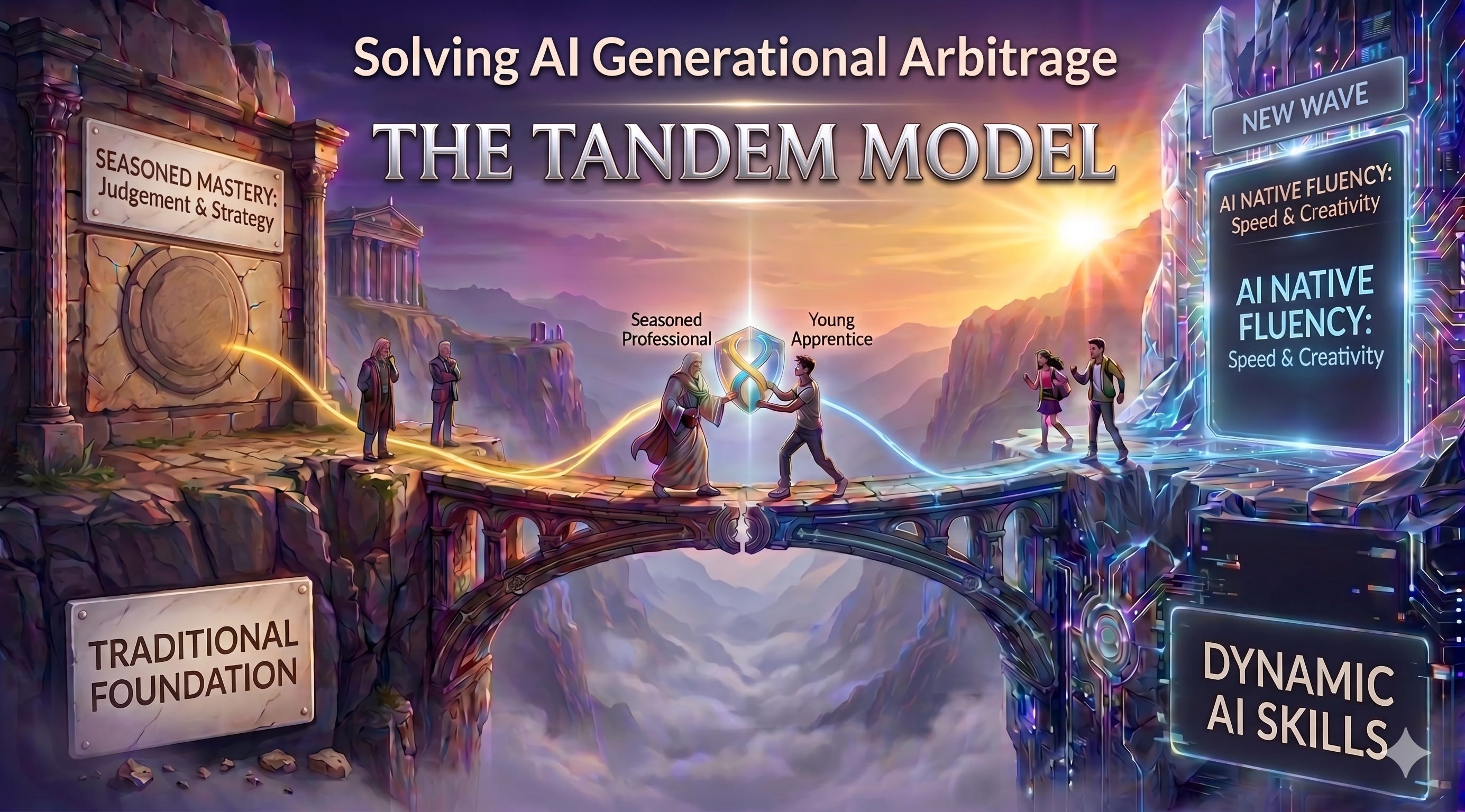
For readers who have been following these essays, the Tandem Model is a significant piece of the larger Afterlife Playbook I have been working through across earlier pieces, and I will continue to develop it in subsequent ones. What I want to focus on here is the broader pattern it sits inside, because the unique organization dynamics is not actually new. This one is particularly impactful because the technology shift is unusually large, but once you start looking for the pattern you find it everywhere underneath the most consequential business breakthroughs of the last twenty years.
Almost every revolutionary business idea in modern memory has come from connecting two things that nobody had previously thought to combine. Uber is the cleanest example and the one most people forget the actual mechanics of, because the breakthrough was not the ride-hailing application itself but the recognition that GPS was already in everyone’s pocket and that the taxi experience was already broken, and that these two facts could be joined into a single product that obsoleted an entire industry. Garrett Camp did not invent global positioning, and he did not invent dissatisfaction with hailing a cab on a cold night in Paris. He saw that they belonged together and that nobody else had walked across the bridge between them yet, and the act of walking across that bridge was worth tens of billions of dollars within a decade.
Spotify did the same thing again with music, this time bridging licensing infrastructure and recommendation algorithms in a way that the established players in either domain could not see from where they were standing. The labels thought they were in a rights business, and the algorithm engineers thought they were in a software business, and Daniel Ek saw that the listener did not actually want either thing in isolation. The listener wanted a playlist that knew them personally, served by a system that had paid the artists fairly, and the entire industry reorganized around that synthesis within a decade despite the fact that everyone involved was already operating with most of the necessary pieces already in hand.
The pattern in these and other similar cases is the same, and it is the same pattern I have been seeing emerge from the tandem pairings at smaller scale across the work I am doing now. Revolutionary value does not come from going deeper into a single discipline. It comes from connecting two disciplines that had been kept apart for reasons that turn out, in retrospect, to be mostly accidental, or even circumstantial.
What I am proposing, and what I have been building in practice for some time, is the macro version of this pattern applied deliberately rather than accidentally. Take the deep mastery that seasoned professionals have accumulated over decades, the judgment and the strategic instinct and the leadership and the critical thinking that no model is going to replicate any time soon, and pair it directly with the dynamic creative fluency of professionals who think in AI as their first language rather than as a tool they had to learn later. Put them together in front of a real problem and let them argue, sketch, prototype, and iterate as equals. Not to optimize the old way of doing things, although that is a pleasant side effect. To revolutionize what the work even is in the first place, which is what every cross-domain synthesis in the historical record has actually accomplished.
The arbitrage opportunity is real, the spread is wider than at any point in my professional lifetime, and the window is open right now in a way that will not stay open indefinitely. Both sides of the gap are sitting on assets that are dramatically more valuable when joined together than when held in isolation, and the organizations that figure out how to bring those two populations into the same room, into the same conversation, into the same working tandem, are going to look in ten years the way Uber looked to the taxi industry in 2012. The ones that do not are going to look the way the taxi industry itself looked, which is to say defensively confused about what just happened to a business they had spent their entire careers mastering.
The bridge is right there, fully constructed, waiting to be walked across. Most organizations are still standing on one side of the canyon, looking across, wondering why the other side feels so far away when in fact it is not far at all. It just needs the tandem.